Consciousness and Prayer
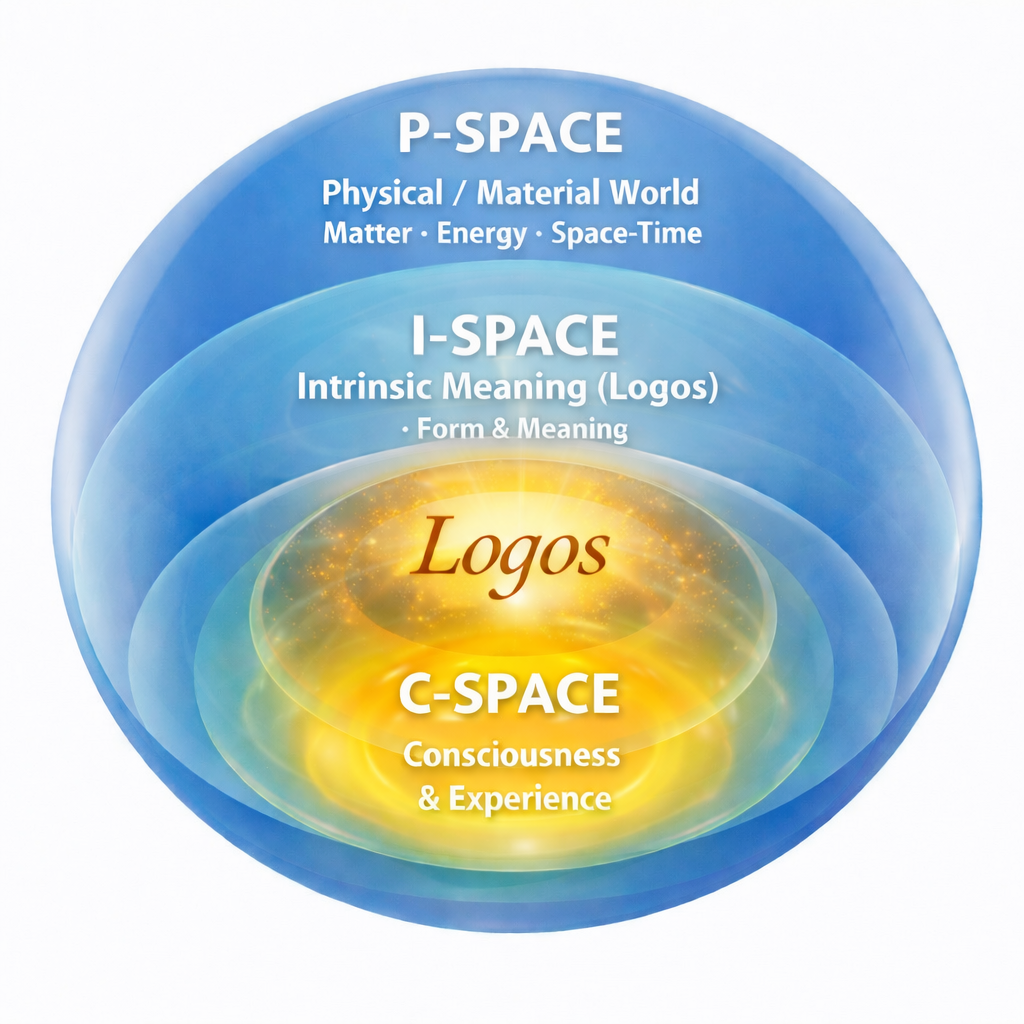
Reality is "Meaning Expressed".
This diagram depicts an indivisible view of reality in which Federico Faggin's imagining of reality,
in concert with the Biblical view expressed in the Gospel of John,
suggest that consciousness (C-space)
and intrinsic meaning (I-space) are inseparable,
and that the physical world (P-space) is their outward expression
in matter, energy, and space-time.
Meister Eckhart and Federico Faggin share the conviction that reality is grounded in an indivisible unity beyond matter.
Eckhart approaches it through contemplative unknowing,
while Faggin articulates it as consciousness and intrinsic meaning prior to the physical world.
In other words:
Eckhart discovers the One by emptying the mind;
Faggin defends the One by rethinking reality.
Medieval mystics such as Meister Eckhart spoke of an ultimate Unity beyond all images, names, and distinctions,
a ground of being in which knower and known are one.
This Unity was not grasped by analysis but entered through detachment, silence, and direct participation.
Creation was understood not as something separate from its source, but as an ongoing expression of it,
a flowing outward of the One into the many without loss or division. Language strained here, and paradox became the guardian of truth.
Federico Faggin approaches this same depth from the opposite direction: not through unknowing,
but through a re-examination of what science assumes to be real.
By placing consciousness and intrinsic meaning prior to physical processes,
Faggin gives conceptual form to what the mystics encountered experientially.
His C-space and I-space articulate, in modern terms, the inner life of the Unity that Eckhart could only gesture toward.
Where the mystic protects the One by silence, Faggin seeks to protect it by rethinking the foundations of physics itself.
Within I-space, Logos names meaning as ontologically primary,
not as language or abstraction, but as the inner intelligibility by which reality is and is knowable.
Conscious experience does not create meaning, nor does matter generate consciousness;
rather, meaning and awareness co-arise and are expressed physically.
What appears as the material universe is thus not the source of meaning, but its manifestation.
In other words: Creation is Meaning Made Manifest.
In the Greek world of the New Testament, Logos carried a dense cluster of meanings:
- intelligible order
- inner meaning or rationale
- that which makes something what it is
- the principle by which things are knowable
- not merely spoken words, but meaning expressed
The Biblical Declaration.
In the language of the Gospel of John, “In the beginning was "The Word" (Logos"),
this diagram gives visual form to that Biblical declaration by locating Logos within I-space as intrinsic meaning,
as the inner intelligibility by which all things are created and known.
C-space names conscious participation in this meaning,
while P-space represents creation as its physical expression in matter, energy, and space-time.
"The Word" is thus not external to the world, nor identical with it, but present as its sustaining meaning.
Creation is not mute matter awaiting interpretation; it speaks because it is already grounded in Logos.
The Word Within All Things.
Before there is speech or thought, there is meaning.
The Bible tradition names this depth Logos, not as a sound uttered, but as the inner truth by which all things arise and are known.
In this image, meaning dwells at the heart of reality,
inseparable from awareness and expressed as the world we touch and see.
To pray, to attend, to be still, is not to summon the divine from elsewhere, but to awaken to what is already present.
Creation does not point away from God; it shines from within.
In the language of the Gospel of John, the Word through whom all things came to be is not distant from what has been made, but is already present as its light and life.
The world is intelligible because it is spoken from within by the Logos;
it bears meaning not as a message sent elsewhere, but as a radiance sustained from its Source.
To behold creation truly is not to look past it toward God, but to see it illumined by the Word that is already in it.
"The light shines in the darkness", not by abolishing the world, but by dwelling within it,
so that seeing, believing, and abiding become one movement of attention.
Understanding 'Prayer' to be "whatever we do to open ourselves to the presence of the Divine Mystery,
related research (e.g. that of the HeartMath Insitute)invites us to consider how intentional states,
especially compassion, are not merely inner feelings, but lived realities that shape the body and our relationships.
When viewed through Federico Faggin’s understanding of C-space, I-space, and P-space, these findings begin to make intuitive sense without asking us to overreach beyond what is solidly known.
At the most grounded level, the evidence is clear:
intentionally cultivating a heartfelt, compassionate state can measurably change our own physiology.
When we attend with care, appreciation, or kindness, the body often responds with greater balance,
seen in heart-rate variability patterns, calmer nervous system activity, and reduced stress markers.
In Faggin’s terms, this begins in C-space as a lived act of compassionate attention.
That intention carries I-space meaning - a sense of care, connection, and safety,
which then expresses itself in P-space as greater physiological order.
Prayer or compassionate intentionality, understood this way,
becomes a repeatable act of aligning awareness with meaning, allowing the body to follow.
This same dynamic extends naturally into our relationships.
We human beings do not regulate ourselve in isolation;
we continually influence one another through voice, presence, timing, facial expression, and shared attention.
A calm, compassionate person often helps another person settle,
not through force or instruction, but through presence itself.
Here again, a C-space state carries I-space meaning (“you are safe,” “you are seen”),
which is communicated through ordinary P-space channels and can measurably affect another’s physiology.
This form of interpersonal co-regulation fits comfortably within both mainstream science and Faggin’s insistence
that meaning is fundamental, not incidental.
Some HeartMath proposals go further,
suggesting that intention may sometimes have effects that are not fully explained by direct physical interaction.
Within Faggin’s framework, such claims are at least conceptually imaginable:
if meaning and consciousness are primary, then relationships in I-space need not always be tightly bound to familiar physical channels.
At the same time, these possibilities remain the most tentative and require the greatest care.
Until such effects are consistently demonstrated and independently replicated,
we hold them as open questions rather than settled conclusions.
Taken together, the picture that emerges is both modest and profound.
The strongest HeartMath findings align cleanly with Faggin’s vision:
compassionate intentionality begins in awareness, reorganizes intrinsic meaning, and becomes visible as bodily coherence.
Our presence can support not only our own well-being, but that of others, through ordinary relational pathways.
Beyond this, further possibilities may exist, but they invite patience, humility, and continued inquiry rather than certainty.
In this light, compassion is not a vague ideal.
It is a meaningful orientation of consciousness - one that quietly shapes bodies, relationships, and perhaps more, from the inside out.
For Paul Tillich, God is not a being among beings,
not a supernatural agent who intervenes from outside the world.
God is:
- Being-itself, not an object within reality
- The depth that makes all existence possible
- The sustaining ground from which life continually arises
Tillich’s concern was that ordinary prayer often turns God into:
- a cosmic problem-solver,
- a super-person issuing interventions,
- or a rival cause among other causes.
That, for Tillich, was a form of idolatry.
So he insisted that God does not act instead of natural processes,
but through the depth of being that sustains them.
The following prayer reflects Tillich’s understanding of God,
and that healing is not an intervention imposed from outside,
but a restoration that occurs when life is allowed to reconnect with the depth that sustains it.
In other words:
To pray for healing is not to ask God to change reality, but to allow reality to be held again by its deepest ground.
A Communal Prayer for Healing
Holy Mystery,
Source of life and love,
we come together not to instruct you,
not to press our own desires,
but to open ourselves to your wisdom.
We hold before you those in need of healing -
those whose bodies are burdened,
whose minds are weary,
whose spirits are strained.
We name them now, aloud or in silence.
(pause)
We ask not that events unfold according to our fears or hopes,
but that your deeper intention for wholeness
be free to come to pass.
Where life has fallen out of balance,
let balance be gently restored.
Where there is pain,
let compassion do its work.
Where there is confusion or fear,
let clarity and peace return.
Teach us to trust enough
to step out of the way,
to release our grasping,
to quiet our anxiety,
to consent to your healing work
as it takes the form it must.
If healing comes through change,
we give thanks.
If it comes through endurance,
we open ourselves to your strength.
If it comes through acceptance,
we seek your courage and grace.
Restore each life, O God,
not to some imagined ideal,
but to its right rhythm,
to its proper measure,
to its own way of flourishing.
We place both the outcome and ourselves
into your enveloping care,
trusting that whatever unfolds
does so indeed within your ever-faithful love.
Amen.