A Survey of Christian Spirituality
Based on "A History of Christian Spirituality" (1981) by Urban T. Holmes III
Prepared for the "Developing Spirituality" seminar series held in Lowville United Church, Burlington, in 1985.
Redeveloped for online access in 2026 by Wayne Irwin.
Presenting a non-exhaustive survey of
the Emphases, Paths to God, Spiritual Goals, and Other Observations
of the various Periods, Schools, Mystics and Exemplars across the arc of Christian History.
The Early Church
Judaism Prior to Christ
Paths to God
- poverty
- interpreting Scripture allegorically
Spiritual Goals
- mysticism
- wisdom
Other Observations
- grounded in synagogal worship
New Testament Period
Paths to God
- repentance
- constant training like an athlete
- accepting the cost of discipleship
- purity of heart
Spiritual Goals
- the mind of Christ
- light in the midst of darkness
- love (agapé)
- logos (reason)
Other Observations
- the spirituality of the New Testament people is not that of the Jewish intelligentsia; hence more emphasis on the heart than on the mind.
The Apostolic Fathers
Paths to God
- simplicity of heart and single-minded service
- temperance, even of religious zeal
- martyrdom
Spiritual Goals
- knowledge of God (or Light)
- assimilation into Christ (recapitulation)
Other Observations
- the writings of the post-New Testament authors tend to be naïve until the sophisticated discourse of Irenaeus of Lyon.
Paths to God
- living an ascetic life
- absolute solitude
Spiritual Goals
- overcoming inner affliction by prayer
- refrain from esteeming this world and remember the next
Other Observations
- In a vision where the whole world seemed covered with snares and traps. Anthony heard an inner voice declaring that humility was all that was needed for escape.
ATHANASIUS of ALEXANDRIA (info)
- c. 296/8 - 373
- Theologian and Patriarch
- Chief proponent of Trinitarianism
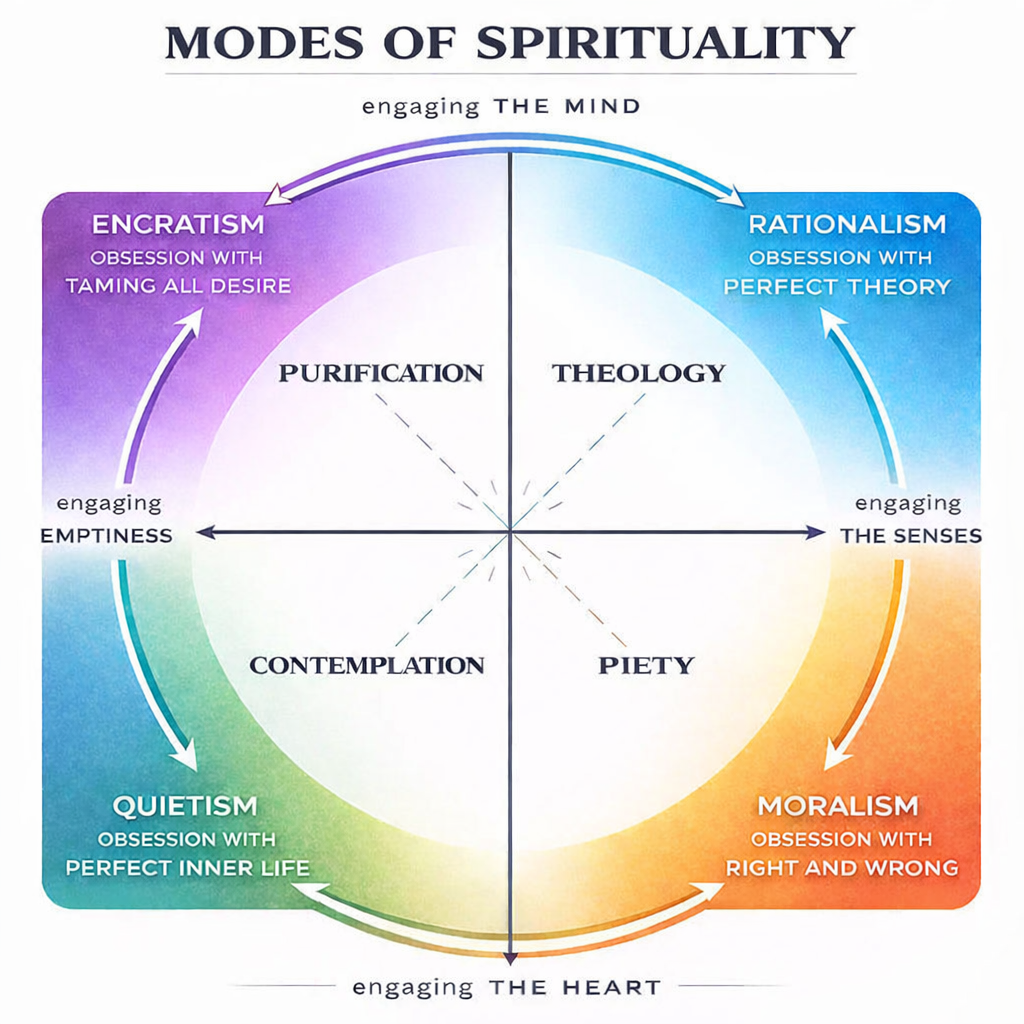
Quadrant: Theology
Paths to God
- accepting Jesus as the Divine Son of God
- holding to "the tradition, teaching, and faith proclaimed by the apostles and guarded by the fathers."
Spiritual Goals
- holding to the concept of the Trinity in the sense that both the Son of God and the Holy Spirit are consubstantial with the Father.
Other Observations
- Jesus Christ is fully God and fully human
- against Arianism, he insists the Son is of the same essence (homoousios) as the Father
- His famous line (paraphrased):
“God became human so that humans might become divine.”
Monasticism
Paths to God
- withdrawal to the deert to face the severe life there as an alternative to martyrdom (anchoritism)
- struggle against boredom and loss of purpose (against acedia)
- the steady ascent up the ladder of perfection
Spiritual Goals
- awakening to the Word of God
Other Observations
- monastics were not "trying to pull themselves up by their selves in order to hear the Word of God
- two forms of ife existed:
eremetial - life in solitude
cenobitical - life in community from time to timer
The Cappadocians
BASIL of CAESAREA (info)
- c. 330 - 379
- (hermit, 358 - 370)
(bishop, 370 - 379
GREGORY of NAZIANZUS (info)
c. 329 - 389
(instrumental in establishing the Nicene faith in the First Council of Constantinople 381)
GREGORY of NYSSA (info)
c. 330 - 395
younger brother of Basil of Caesarea. A thinker and theologian of great originality and knowledge. Sometimes called "the Father of Christian Mysticism"
Quadrant: Purification
Paths to God
- the practice of goodness
- erotic passion for union with God
- sober excitement beyond self-control
- working together with God (synergy)
- engendering an inner quiet (hesychasm)
Spiritual Goals
- growth in goodness
- becoming like God
The Alexandrian School
Paths to God
- poverty
- interpreting Scripture allegorically
Spiritual Goals
- mysticism
- wisdom
Other Observations
- grounded in synagogal worship
The Early Middle Ages (500-1000)
XXX
Paths to God
- poverty
- interpreting Scripture allegorically
Spiritual Goals
- mysticism
- wisdom
Other Observations
- grounded in synagogal worship
The High Middle Ages (1000 - 1300)
XXX
Paths to God
- poverty
- interpreting Scripture allegorically
Spiritual Goals
- mysticism
- wisdom
Other Observations
- grounded in synagogal worship
The Late Middle Ages (1300 - 1500)
XXX
Paths to God
- poverty
- interpreting Scripture allegorically
Spiritual Goals
- mysticism
- wisdom
Other Observations
- grounded in synagogal worship
The Modern Period (1500 - Present)
XXX
Paths to God
- poverty
- interpreting Scripture allegorically
Spiritual Goals
- mysticism
- wisdom
Other Observations
- grounded in synagogal worship